Cows on Floating Farms: Innovating for a Sustainable Tomorrow

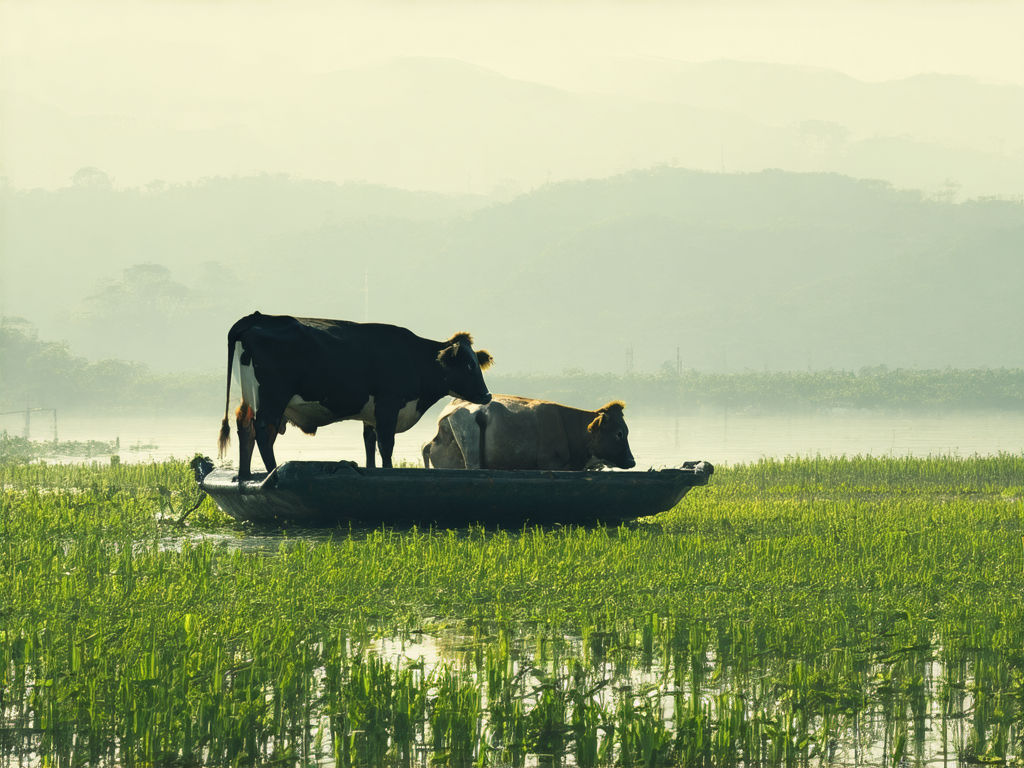
Cows on Floating Farms: Innovating for a Sustainable Tomorrow
In the heart of South Asia, where rivers meander through fertile plains and monsoons bring both life and challenge, a new vision of agriculture is emerging. Floating farms, equipped with grazing cows, are popping up in regions prone to flooding, offering a sustainable solution to one of the world’s most pressing problems: how to feed a growing population without destroying the planet.
These floating farms are not just futuristic fantasies; they are real, functioning enterprises that are transforming lives and landscapes. They represent a convergence of innovation, environmental stewardship, and economic ingenuity—a blueprint for a more sustainable tomorrow.
A Revolution on Water
Imagine a vast expanse of water dotted with circular platforms, each hosting a small herd of cows. These floating pastures are designed to rise and fall with the water levels, ensuring that the animals remain safe and dry even during heavy monsoons. The concept is simple yet ingenious: by utilizing water bodies that would otherwise be idle or prone to flooding, farmers can now graze their livestock in areas where land is scarce or unavailable.
The technology behind these farms is a marvel of modern engineering. Made from durable, lightweight materials like recycled plastic and metal frames, the platforms are anchored to the riverbed using ropes and buoys. Automated feeding systems dispense fodder at regular intervals, while solar-powered pumps ensure that clean water is always available for the cows. Waste management systems collect manure, which can be converted into biogas or fertilizers, further enhancing the farm’s sustainability.
A Lifeline for Marginalized Farmers
For farmers in South Asia, where land prices are skyrocketing and arable land is becoming increasingly scarce, floating farms offer a lifeline. Many of these farmers come from marginalized communities, often forced to graze their livestock in unsafe or ecologically damaging areas. Floating farms provide them with a safe, productive alternative, allowing them to continue their traditional livelihoods without harming the environment or putting their animals at risk during floods.
One such farmer is Ramesh, who lives in the flood-prone district of West Champaran, India. “I’ve been a cattle farmer for over 20 years,” he says, his voice filled with hope. “But every monsoon season, I’d lose some of my cows to drowning or disease. Now, with this floating farm, I can protect my animals and even expand my herd.”
The economic benefits are undeniable. Floating farms reduce the risk of losses due to natural disasters, lower the cost of land acquisition, and increase the efficiency of grazing. Farmers who have adopted this technology report higher yields of milk and meat, as well as improved animal health. This not only boosts their income but also elevates their social standing in the community.
A Model for Global Change
The success of floating farms in South Asia has caught the attention of researchers and policymakers worldwide. Climate change is making extreme weather events more frequent and severe, rendering traditional farming practices increasingly untenable. Floating farms offer a replicable model that can be adapted to various regions, from the deltas of Southeast Asia to the floodplains of Africa.
Moreover, these farms align with global efforts to combat climate change by reducing greenhouse gas emissions and promoting sustainable land use. They also contribute to food security by ensuring a steady supply of protein-rich dairy and meat products in regions where malnutrition remains a significant concern.
Challenges and the Path Forward
Despite their promise, floating farms face several challenges. The initial cost of setting up these farms is high, making them inaccessible to many small-scale farmers. Maintenance requires technical expertise, which can be scarce in rural areas. Additionally, there are concerns about the long-term environmental impact of introducing non-native grazing practices into fragile aquatic ecosystems.
To address these issues, governments and NGOs must invest in research and development, provide subsidies for farmers, and establish training programs to build local capacity. Partnerships with international organizations can help scale up these initiatives and ensure they are implemented responsibly.
A Glimpse of a Better Future
As we stand on the brink of a climate crisis, innovations like floating farms remind us that solutions do exist—if we are willing to think outside the box. They challenge us to reimagine agriculture not as an activity tethered to land but as a dynamic, adaptable practice that can thrive in harmony with nature.
For Ramesh and countless others like him, floating farms are more than just a sustainable alternative—they are a beacon of hope. They symbolize the possibility of reconciling our growing demand for food with the urgent need to protect the planet.
In a world increasingly defined by uncertainty, these cows on floating farms offer a glimpse into a future where progress and sustainability go hand in hand. A future where no one has to choose between feeding their family and preserving the Earth for generations to come.
About the Author:
Sophie Patel is Health and Economics Reporter at our publication. Sophia is an award-winning reporter focusing on economic inequality and global health. Her stories have illuminated the challenges faced by marginalized communities worldwide.